How to Get Rid of Bats in Your Attic in Florida, Humanely and Legally
Exclusion is the only method that works, and in Florida the timing is set by state law. Here is what the process involves, which species you are most likely dealing with, and what happens if you try to seal the entry at the wrong time of year.
How do you get rid of bats in your attic?
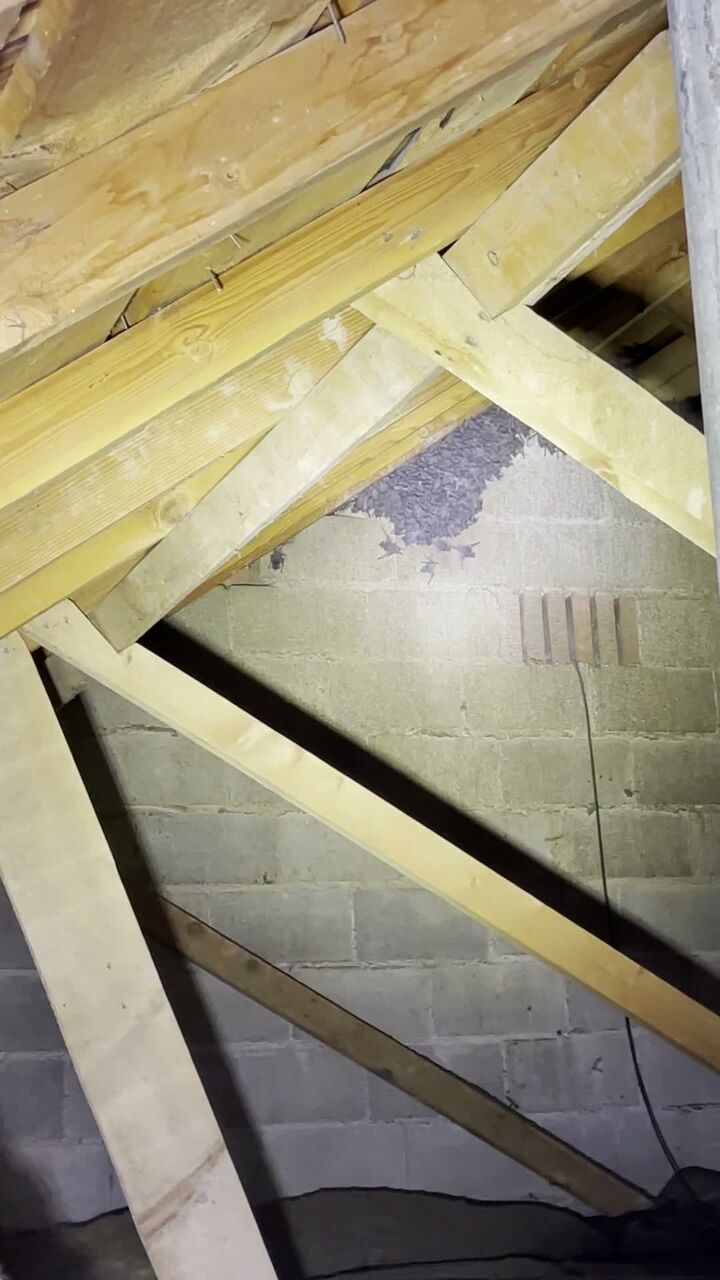
You get bats out with exclusion, not traps or sprays. A trained technician identifies every opening the colony uses, installs one-way devices over the active entries, and waits while the bats exit nightly to feed and cannot return. Per FWC guidance, devices must remain in place for at least four consecutive suitable warm nights. Once the roost is empty, every gap is permanently sealed and the contaminated space is cleaned. That is the humane, legally compliant method available to Florida homeowners.
Exclusion works because it follows the bats' normal nightly exit pattern. Every night after dark, a colony exits in search of insects. A one-way valve, typically a tube, a screen cone, or a weighted flap, lets each bat drop out normally but blocks the return trip. Within a week the entire colony has vacated on its own. No trapping, no poison, no animals sealed inside the wall.
Is it legal to remove bats yourself in Florida?
This is where Florida is different from most states, and the law is not a guideline. Florida bats are protected nongame wildlife under Florida Administrative Code rules 68A-4.001 and 68A-9.010, which prohibit killing, trapping, or excluding bats from any occupied structure during the maternity season. That season runs from April 16 through August 14. You can confirm the dates and the legal authority directly on the Florida Fish and Wildlife Conservation Commission website.
Why the prohibition? Female bats gather in attics, barrel-tile roofs, and soffit spaces in mid-spring to give birth. The pups are born hairless and completely flightless. For roughly the first six weeks of their lives they cannot follow their mothers out of the roost at night. If a homeowner or company seals the entry during this window, the mothers are locked away from their young. The pups die inside. What started as a bat problem becomes a decomposition problem inside your walls and attic.
The legal window for exclusion is August 15 through April 15. Any company that offers to exclude a colony in May, June, July, or the first two weeks of August without a specific emergency permit is operating outside Florida law. Florida has one of the strictest maternity prohibitions in the country, and the April-through-August window is notably longer than what most other states impose. The FWC living-with-bats page covers the full scope of what is and is not allowed.
The bats most likely in a Florida attic
The Brazilian free-tailed bat (Tadarida brasiliensis) is Florida's dominant structure-roosting species and one of the most commonly reported structure-roosting species across the state, according to FWC. It is a medium-sized, dark-gray bat with a characteristic tail that extends beyond the tail membrane, long narrow wings built for speed, and a flat, wrinkled muzzle. What makes it such a persistent attic tenant is colony size: a single roost under a barrel-tile roof in Orlando or Tampa can hold hundreds to several thousand individuals. These bats are found statewide, they roost almost exclusively in man-made structures, and they return to the same roost year after year. The University of Florida bat houses in Gainesville, which host one of the largest occupied bat-house colonies in the world, are nearly all Brazilian free-tails.
The evening bat (Nycticeius humeralis) is the second most frequently encountered species inside Florida homes. Smaller than the Brazilian free-tail, with short rounded ears and dull brown fur, it forms maternity colonies of 30 to a few hundred in attics, behind shutters, and inside wall voids. In Florida, evening bat females commonly give birth to twin pups, which is one reason colonies can grow quickly when left alone.
One species deserves special mention because the legal stakes are entirely different. The Florida bonneted bat (Eumops floridanus) is the largest bat in Florida and one of the rarest mammals in North America. It is federally Endangered under the U.S. Endangered Species Act, as confirmed by the FWC Florida bonneted bat profile. Its range is limited to South and Central Florida, roughly from Polk and Charlotte counties southward, and it has been documented roosting under barrel-tile roofs in some of those counties. If you suspect you may have Florida bonneted bats, do not attempt any exclusion or disturbance. Contact a permitted professional who will coordinate directly with FWC before any work begins.
Other species you may encounter include the big brown bat (Eptesicus fuscus), more common in the Panhandle and northern Florida, and the tricolored bat (Perimyotis subflavus), a tiny yellowish bat proposed for federal Endangered listing due to white-nose syndrome. The full roster of Florida's 13 native bat species is on our bat species in Florida page.
What the signs look like
In Florida's subtropical climate, the signs of a bat colony read differently than they do in a dry northern state. Start with the guano. In high heat and humidity, bat droppings do not desiccate quickly the way they do in an arid climate. Fresh guano in a Florida attic can be moist, dense, and pungent, sometimes with a wet, ammonia-forward smell that penetrates drywall and ceiling material faster than homeowners expect. A pile of Florida bat guano, especially from a large Brazilian free-tail colony, can begin to smell within days and the odor intensifies through the summer months when temperatures inside an attic regularly exceed 130 degrees Fahrenheit.
Look for guano accumulating directly below a roofline entry point: along the fascia, inside the soffit, at gable vents, at barrel-tile gaps at the eave, or at chimney flashing joints. Bat droppings crumble to a dark, glittery powder when dry and have a strong musty odor in any amount. You will also see dark, greasy brown staining around active entry points, left by the oils and guano that transfer from the bats' fur as they squeeze through repeatedly.
Because Florida bats are active nearly year-round, unlike bats in colder states that retreat to caves in winter, an active colony here is one that continues producing fresh signs in every month. Florida bats typically remain active through winter, so fresh signs in any month are normal. If you are seeing fresh staining and guano in January, it is because the colony never left.
Why repellents and sealing the hole backfire
Ultrasonic repellers, mothballs, bright lights, and peppermint-based sprays do not move an established colony. These animals navigate by echolocation and have spent weeks selecting the roost. A plug-in device does not disturb that calculation. No commercially available repellent reliably moves an established colony. FWC does not recommend lights, sounds, toxic substances, or repellents as a bat-removal method.
Sealing the hole is more dangerous. If you seal the primary entry without confirming the colony has fully exited, you trap the animals inside. During maternity season that is a violation of Florida law. Outside of maternity season it still creates a serious problem: bats trapped inside will find alternate routes out, which often means into your living space rather than outdoors. A colony forced into the wall will produce a decomposition smell if the animals cannot escape, and the guano that was contained to the attic is now distributed through wall cavities. What should have been a sealed rooftop gap becomes a remediation job.
What the removal process looks like
A legal, complete bat exclusion in Florida runs in four stages.
Inspection. We walk the full roofline at dusk, looking for every opening the colony uses, gable vents, barrel-tile gaps, fascia joints, ridge cap separations, chimney flashing, and any soffit breach wider than a quarter inch. We also inspect the attic to assess colony size and the extent of guano accumulation. This step determines scope, cost, and schedule.
Exclusion device installation. One-way devices go over every active entry point. Secondary gaps that are not currently in use are sealed in the same visit so the colony cannot pivot to them once the primary exits are restricted. We schedule this work to begin no earlier than August 15, after the FWC maternity prohibition lifts, and we complete the sealing phase before April 16 the following year.
Monitoring. The devices stay in place for at least four consecutive suitable warm nights, often five to seven days. Each night the colony exits to feed. Each morning we confirm activity has decreased. Once the colony has cleared, we remove the devices.
Permanent sealing and cleanup. Every entry point is sealed with materials appropriate to the structure, caulk, hardware cloth, foam backer, or wood repair, depending on the location. Where guano has accumulated, cleanup is scheduled separately using proper PPE and HEPA equipment. In Florida's heat, guano decomposes faster than it does in cooler climates, which can create conditions favorable to Histoplasma fungal growth and makes prompt cleanup a priority.
The real risks: guano and rabies
Bat guano is the source of two of the primary health concerns associated with bat colonies. The first is histoplasmosis, a respiratory illness caused by inhaling spores of the fungus Histoplasma capsulatum, which grows in accumulated bat or bird droppings. The CDC warns that exposure to disturbed droppings is the main route of infection. In Florida, attic temperatures above 100 degrees Fahrenheit through much of the year accelerate decomposition and, with it, the conditions in which the fungus can grow. Do not vacuum, sweep, or disturb a dry guano deposit without a properly fitted respirator. This is not a job for a shop vac and a dust mask.
The second risk is rabies. Bats are a confirmed rabies vector in Florida. The chance that any individual bat carries the virus is low, but a bat bite can be too small to feel, particularly during sleep. If anyone in your household has had direct, unprotected contact with a bat, contact your county health department. Do not release the bat until you have spoken with health officials. If you find a bat in a room where someone was sleeping, that is a potential exposure event regardless of whether a bite is visible. The CDC rabies exposure guidance lays out the steps to take.
Beyond the biological risks, a long-running colony produces guano that soaks into insulation and framing, degrades the R-value of your attic, stains ceilings, and eventually requires full insulation replacement. In Florida's humidity, the urine component accelerates wood rot faster than it would in a dry climate. The longer you wait, the more the repair bill grows.
When to call Florida Wildlife Specialists
Call as soon as you suspect a colony. Bat colonies do not shrink on their own. Year over year the numbers grow, and so does the guano accumulation, the odor, the health exposure, and the eventual remediation cost. The best time to act is the moment you notice activity, staining, or smell.
If you are reading this during the exclusion window, August 15 through April 15, we can schedule immediately. If you are reading this during the April 16 through August 14 maternity prohibition, we can still inspect the roofline, document the colony, and put you at the front of the schedule for the August 15 opening. That way the work begins the day the legal window opens rather than weeks later. Waiting until late summer and then discovering you are behind a queue of other homeowners is common in Florida. Calling now, even if exclusion cannot start yet, gets the inspection done and puts you at the front of the schedule for the August 15 opening.
We serve homeowners across Central Florida, South Florida, the Tampa Bay area, and the Space Coast, from Orlando and Kissimmee to Fort Myers, Cape Coral, and Jacksonville. Call us at (407) 917-6672 or visit our Florida bat removal page to schedule a free inspection.
Frequently asked questions
Can bats be removed from my Florida home in summer?
No, not with exclusion. Florida Administrative Code rules 68A-4.001 and 68A-9.010 prohibit bat exclusion from any occupied structure during bat maternity season, which runs from April 16 through August 14. During that window, flightless pups are in the roost and sealing the entry would trap and kill them. A bat that has entered your living space can still be handled as a separate emergency, but full colony exclusion must wait until August 15 at the earliest. If you discover a colony during summer, call us now to schedule an inspection and get on the calendar for the fall opening.
Which bat species is most likely in my Florida attic?
The Brazilian free-tailed bat (Tadarida brasiliensis) is by far the most common bat found in Florida structures. It roosts in attics, under barrel-tile roofs, in soffits, and in wall voids in colonies that can reach into the hundreds or thousands. The evening bat (Nycticeius humeralis) is the second most frequently encountered structure bat in Florida homes. Both are fully protected under Florida law.
How do I know if I have a bat colony and not something else?
Bat guano is the clearest indicator. It accumulates directly below an entry point and crumbles to a dark, glittery powder when dry, unlike the firm, round pellets left by mice or rats. In Florida's humidity, fresh guano has a strong, wet ammonia odor that can penetrate drywall. You may also see dark, greasy staining around fascia gaps or soffit joints, and hear faint chittering or a rustling sound near dusk when the colony exits to feed. A single bat found inside your living area can indicate several things. If you are also seeing guano, staining, or dusk activity at a roofline gap, a nearby colony is more likely. Either way, contact us so we can assess the situation.
What does a written bat-free warranty cover?
Our written bat-free warranty covers every entry point we seal during the exclusion. If bats re-enter through any location we closed, we return at no charge. The warranty is provided after the exclusion work is complete, once the colony has cleared and all openings have been permanently sealed.
Wildlife in your home? Contact us today.
Call to schedule an inspection.